


Charging time directly affects how many trips your electric tuk tuk can complete per day. Choosing the wrong setup will limit your fleet’s daily revenue.
Charging an electric passenger tricycle typically takes 8 to 15 hours with standard chargers. This time depends on the battery capacity and the charger power. Larger batteries provide a longer driving range. However, they require more charging time. You must balance daily commercial operation needs with efficient schedules.
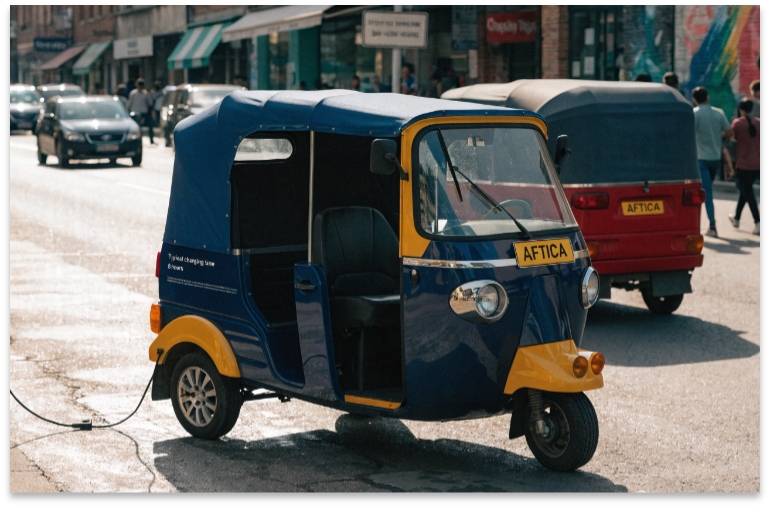
In this guide, we break down real charging times based on actual battery setups. We will help fleet operators and distributors choose the right equipment for their projects.
What Is the Typical Charging Time for an Electric Tuk Tuk?
You need your vehicles on the road making money. You do not want them stuck on a plug. Understanding the standard charging window prevents scheduling disasters for your taxi business.
Most commercial electric passenger tricycles need 8 to 10 hours to charge fully using a standard 10-amp charger. High-capacity batteries can take up to 15 hours on small chargers. Therefore, overnight charging remains the most practical strategy for daily commercial fleet operations.
Let us look at a real taxi fleet operation. A driver finishes a long 10-hour shift. The vehicle returns to the depot. At this point, the battery is rarely completely empty. Drivers usually return with 20 percent power remaining. This habit prevents damage to the battery cells. You plug the vehicle into a standard 220V wall socket. The charger pushes energy back into the battery at a steady rate over the next 8 to 10 hours.
The charger works in two steps. First, it pushes a steady current to fill the battery to 80 percent fast. Second, it switches to a steady voltage. It slows down to balance the battery cells safely. This prevents overheating. Most electric passenger tricycles use this exact overnight charging cycle. This design makes them highly practical for daily commercial use. The driver goes to sleep. By the next morning, the vehicle is ready for another full day of work. You do not need expensive commercial charging stations for this basic setup. You just need a safe power line in your garage. We will explain the differences between fast charging and standard charging in another guide. For now, you must plan your fleet schedules around this standard overnight window. This keeps your business running smoothly.
Charging Time by Battery Type (Real-World Comparison Table)
You want maximum range for your drivers. But picking the biggest battery creates problems if you do not calculate the charging time. This mistake will disrupt your entire daily dispatch schedule.
Charging time changes based on the battery size and the charger power. A 60V 100Ah battery takes about 8 to 10 hours with a 10A charger. A 150Ah battery on that same charger can take up to 15 hours. This delay directly impacts your daily routes.
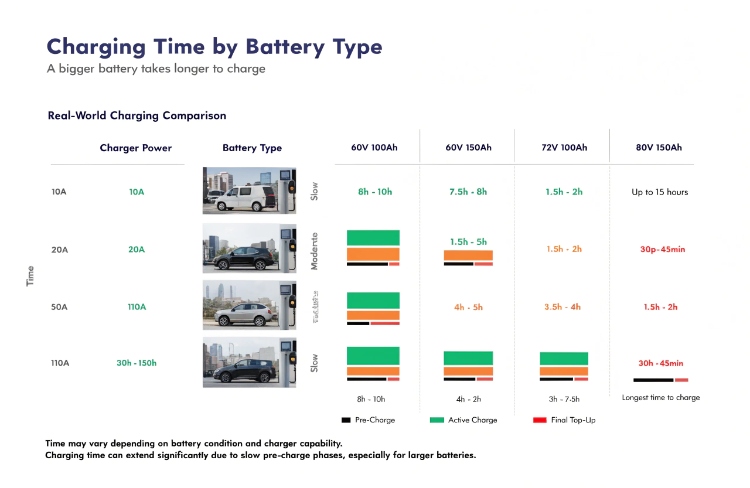
Charging time varies significantly. Below is a practical reference table. We use this data in real factory projects. I calculated these times mathematically based on a standard 220V power supply. You can calculate this yourself easily. You divide the pil kapasitesi (Ah) by the charger output (Amps). Then you add about 15 percent extra time. This extra time covers the slow charging step at the end of the cycle. These estimates assume the battery drops to 20 percent before charging begins. This matches actual daily use in the electric passenger tricycle business.
| Pil Türü | Charger Output | Estimated Charging Time (20% to 100%) | Typical Usage Scenario |
|---|---|---|---|
| 60V 100Ah | 10 Amps | 8 – 10 hours | Small fleets / short-distance city shuttles |
| 60V 150Ah | 10 Amps | 13 – 15 hours | Medium daily operation / suburban routes |
| 72V 100Ah | 10 Amps | 8 – 10 hours | Long-range passenger transport / heavy loads |
| 72V 150AH | 15 Amps | 8 – 10 hours | Fleet operation with higher efficiency needs |
Look at the table above. Larger batteries require more charging time. They also provide longer driving ranges. This long range is critical for commercial passenger transport. Notice that the voltage does not change the charging time. A 60V 100Ah battery and a 72V 100Ah battery both take 8 to 10 hours on a 10-amp charger. Only the battery capacity and the charger amps matter for time calculations. For fleet operators, choosing the right balance between charging time and range is more important than simply selecting the largest battery. A large 150Ah battery creates problems if you use a small 10-amp charger. It will take 15 hours to charge. Your drivers only sleep for 8 hours. You must match the battery size to your specific daily schedule. Then you must upgrade the charger to match. Note: Actual charging time may vary. Battery condition, charger efficiency, and local power supply stability all affect the final time.
How Charging Time Affects Daily Fleet Operation
You buy vehicles to generate profit every single hour. An electric tuk tuk loses money when it stays connected to a wall. Long charging times will drop your daily revenue sharply.
In real operations, charging time determines how many trips a vehicle can complete per day. A vehicle charging for 14 hours only has 10 hours left to earn money. Managing this strict balance dictates your fleet's profitability and overall market competitiveness.
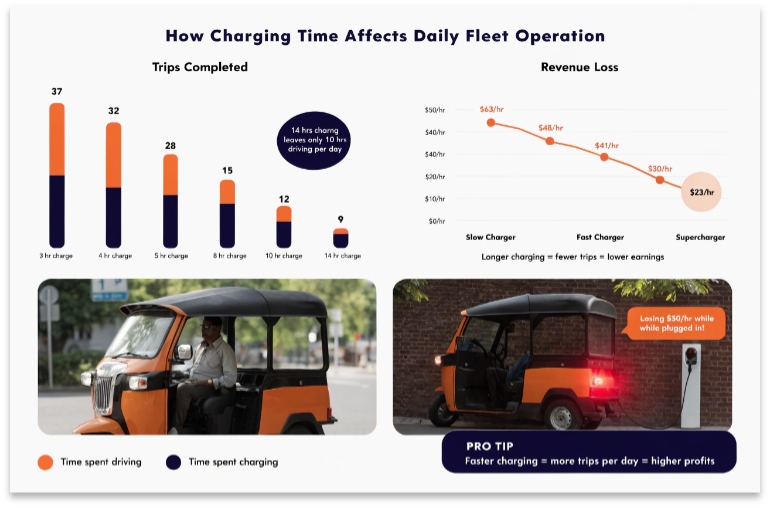
Time equals operational capacity. In the commercial transport business, a parked vehicle is a dead asset. You must map out your operations when you manage an electric passenger tricycle fleet. You need to know exactly how many trips a driver can make. Then the battery needs power again. Your market might require a vehicle to run for 14 hours a day to make a good profit. In this case, an 8-hour overnight charge fits perfectly. The driver works all day. They park the vehicle at night. It charges while they sleep. This is the standard cycle in many Asian and African markets. Single owners operate their own rickshaws this way.
However, some businesses run a 24-hour taxi service. Multiple drivers share one vehicle. A standard 10-hour charging block will ruin this business model. In this case, drivers use daytime opportunity charging. They plug the vehicle in for one or two hours during lunch breaks. They also charge between shift changes. Drivers almost never charge from zero percent during the day. They top up the battery when it drops to 40 percent. This strategy keeps the electric passenger rickshaw on the road during busy customer hours. In real operations, charging time dictates your trip limits. You must align your battery choice with your actual daily operating hours. This alignment maximizes your revenue.
Slow Charging vs Faster Charging Options in Real Projects
You hear about fast chargers and think they will solve all your downtime problems. But mixing the wrong charger with your batteries will cause expensive damage to your fleet.
Standard slow charging is the safest method for electric passenger tricycles. Faster charging options exist to reduce downtime. However, they require specific battery types and heavier wiring to handle the increased heat safely. This prevents permanent battery damage.
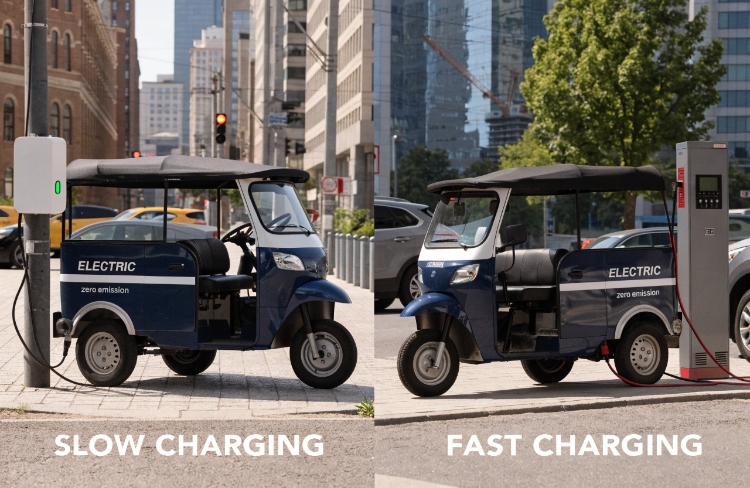
We use standard chargers in most entry-level projects. Standard chargers provide sufficient power. Large fleet operations may require higher efficiency solutions. A standard 10-amp charger connects easily to regular 220V wall outlets. These outlets are common in residential homes. This slow charging method generates very little heat. Low heat is excellent for the battery. It means the internal battery cells degrade slowly. This extends the overall lifespan of the battery pack. You want to keep replacement costs low when you manage a new fleet. This makes standard slow charging the best financial choice. Most B2B buyers choose this method for their first imports.
However, large commercial fleet operations face different daily pressures. Your electric passenger rickshaws might operate in crowded city centers. You might need them to charge faster during brief driver shift changes. You can upgrade to 15-amp or 20-amp chargers. This upgrade cuts the charging time down significantly. But you must verify your equipment first. You must make sure the battery's internal management system can handle this extra power. The vehicle's wiring must also be thick enough. Pushing too much current into a standard battery will cause it to swell. It will overheat and fail permanently. We cover this technical topic deeply in our Fast vs Slow charging article. We also discuss broader infrastructure setups in our Charging Station guide. Faster charging always costs more money upfront. It requires careful technical matching before you place your factory order.
How to Choose the Right Charging Setup for Your Fleet
You face many different battery and charger combinations. Picking the wrong setup wastes your capital. It will also leave your drivers without enough power to finish their customer routes.
Your choice depends entirely on your business model. Small importers need standard setups. Active taxi fleets need larger batteries with efficient chargers. Government projects require custom combinations to meet strict daily transport demands without causing local grid overloads.
I separate B2B buyers into three distinct categories. I base these categories on my factory export experience. First, we have small importers or startup businesses. You might just be testing the market with a few vehicles. I strongly recommend a 60V or 72V 100Ah battery for you. You should pair this with a standard 10-amp charger. This setup is reliable and inexpensive. It perfectly handles basic daily operations. Your drivers will charge overnight for 8 to 10 hours. They will drive all day without any complicated technical instructions.
Second, we have professional fleet operators. You run dedicated electric passenger tricycle taxi services. Your drivers need a long range. They want to maximize daily fares and stay out during peak rush hours. I suggest a 72V 150Ah battery for you. You must pair this with a higher-efficiency 15-amp charger. This combination guarantees long driving distances. It also keeps the overnight charging time strictly under 10 hours. This ensures the vehicle is fully ready every single morning.
Third, we handle large government or NGO transport projects. These projects operate in difficult areas. They often face unstable power grids or strict daily schedules. We must design a custom combination for these buyers. We match the battery size, charger output, and vehicle weight limits perfectly. This ensures the fleet keeps moving without blowing local transformers. You must evaluate your local grid stability and your drivers' daily habits. Do this before you sign a purchase order. If you are planning an electric tuk tuk project, we can recommend the most suitable battery and charging solution. We will base this on your market conditions, usage scenario, and budget.
Çözüm
Charging an electric tuk tuk typically takes 8 to 15 hours. You ensure maximum daily fleet profitability by perfectly matching battery capacity and charger output to your specific operating schedule.
